New Method to Analyze Positive and Negative Interactions in Microbial Communities
Multispecies microbial communities play a vital role in healthcare, environmental sustainability, and biotechnology. Understanding the interactions within these communities is essential for maintaining their stability and functionality. Traditionally, these interactions have been characterized by the net positive or negative effects one species has on another. This simplistic view, however, overlooks the complexity of microbial interactions, which can include both positive and negative influences simultaneously. A recent study has developed a new method aimed at disentangling these components, providing a more detailed understanding of microbial behavior.
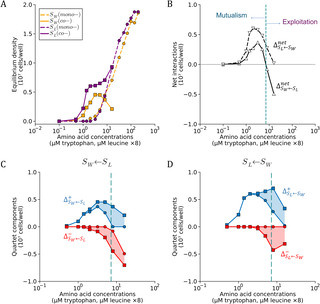
The researchers conceptualized a theoretical framework that allows for the estimation of positive and negative components of interspecies interactions, particularly in scenarios dominated by metabolic exchanges. This method replaces the conventional net interaction characterization with a 'quartet' of components, which includes the positive and negative influences each species exerts on the other. By applying this method to various species pairs, the study revealed that both positive and negative interactions can have comparable strengths and that discrepancies in net interactions can arise from the cancellation of strong effects.
The study utilized data from an in silico model of the oral microbiome and an experimental pair of auxotrophic species to validate their approach. The findings suggest that understanding these underlying interactions can clarify the complex behaviors observed in microbial communities, especially when resource availability fluctuates. This quartet method not only enhances our comprehension of microbial dynamics but also has implications for the design and engineering of microbial communities in various applications, from healthcare to environmental management.
By providing a more fundamental characterization of interspecies interactions, this research paves the way for improved community ecology theories. The ability to quantify both positive and negative components of interactions can lead to better predictions of community behavior, ultimately aiding in the development of more effective strategies for managing microbial ecosystems.