Study Reveals TCEAL7's Role in Myoblast Differentiation Regulated by BRG1 and Calcineurin
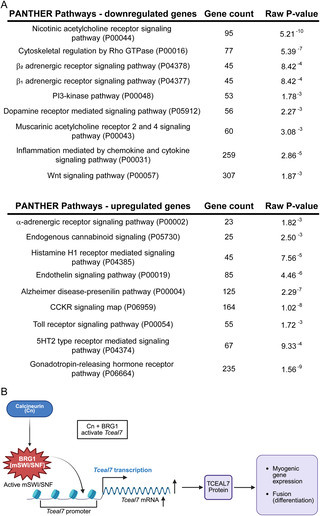
A recent study published in PLoS One has shed light on the role of TCEAL7 in myoblast differentiation, revealing its regulation by BRG1 and calcineurin signaling pathways. The transcriptional control of skeletal muscle differentiation is a complex process that requires the coordinated activity of various transcription factors and chromatin remodelers. The researchers identified TCEAL7, a member of the poorly characterized TCEAL family of proteins, as a direct downstream target of BRG1-containing mammalian SWI/SNF complexes and calcineurin signaling during myoblast differentiation. Their analyses demonstrated that inhibiting BRG1 significantly reduced TCEAL7 expression in differentiating C2C12 myoblasts, indicating the importance of BRG1 in regulating TCEAL7. The study also found that BRG1 occupancy at the TCEAL7 promoter increased during differentiation, correlating with the induction of TCEAL7 expression and its nuclear accumulation. Furthermore, the knockdown of calcineurin also suppressed TCEAL7 expression and impaired myoblast differentiation, suggesting that both BRG1-driven chromatin remodeling and calcineurin signaling converge on TCEAL7 regulation. Functionally, the knockdown of TCEAL7 altered cell proliferation and disrupted myoblast differentiation, primarily due to reduced expression of Myogenin, a key transcription factor in muscle differentiation. RNA-seq analysis revealed that TCEAL7 deficiency led to broad dysregulation of myogenic and metabolic gene programs, including those involved in cell-cycle regulation. This study highlights TCEAL7 as a critical component of the myogenic regulatory network, whose expression is tightly controlled by BRG1 and calcineurin activity, underscoring its importance in muscle development and regeneration.