Optimizing Zinc and Iron Biofortification in Cowpea for Nutritional Security
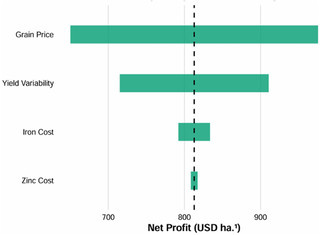
Agronomic biofortification with zinc (Zn) and iron (Fe) has emerged as a promising strategy to enhance crop productivity and improve food and nutritional security. However, traditional fertilizer recommendations often focus solely on maximizing biological yield, which may not align with the economic realities faced by farmers. A study conducted in Mozambique aimed to integrate agronomic and economic analyses to identify optimal Zn and Fe fertilization strategies for cowpea (Vigna unguiculata [L.] Walp.) under tropical field conditions. Utilizing a randomized complete block design with a 3 × 4 × 4 factorial arrangement, the study evaluated three fertilization methods—soil, foliar, and combined soil plus foliar—and four application rates of elemental Zn and Fe. The results indicated that while maximum technical efficiency was achieved at higher application rates of Zn and Fe, maximum economic efficiency was reached at lower rates, significantly reducing Fe input costs while maintaining nearly all of the maximum predicted grain yield. This finding underscores the importance of balancing agronomic performance with economic viability in fertilizer management. The combined application method yielded greater agronomic efficiency compared to either method alone, further supporting the need for integrated nutrient management strategies. The study also employed response surface methodology (RSM) to analyze nonlinear crop responses and nutrient interactions, facilitating the identification of fertilizer combinations that maximize both productivity and profitability. These findings provide an evidence-based framework for developing economically efficient Zn and Fe fertilization strategies tailored to smallholder farming systems in tropical regions. This research highlights the critical link between micronutrient management in agriculture and broader food security initiatives, emphasizing the need for locally adapted nutrient management strategies to combat hidden hunger caused by micronutrient deficiencies. By improving both the productivity and nutritional quality of staple crops like cowpea, agronomic biofortification can play a vital role in enhancing food security and supporting sustainable agricultural practices.