Social Context Influences Food Anticipatory Activity and Thermoregulation in Mice
Food anticipatory activity (FAA) is a behavioral response observed in many animals, characterized by increased locomotor activity prior to scheduled feeding times. This phenomenon is closely tied to circadian rhythms, which are influenced by various environmental cues, including food availability. A recent study published in PLOS One explored how social context impacts FAA in mice, an area that has not been extensively studied due to the historical focus on individually housed animals.
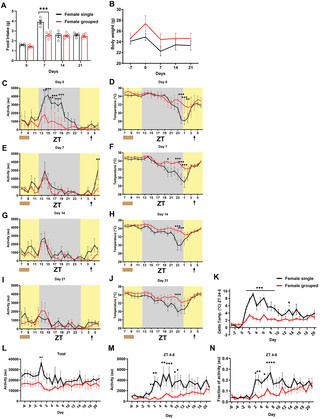
Researchers from California State Polytechnic University Pomona utilized advanced monitoring techniques to assess locomotor activity and body temperature in both singly and group-housed male and female C57BL/6J mice. Their findings revealed that social housing significantly suppressed FAA in both sexes, with a more pronounced effect in males. Additionally, the preprandial rise in body temperature, which typically accompanies FAA, was notably reduced in group-housed mice compared to their singly housed counterparts.
The study highlights the importance of considering social factors when examining circadian biology and metabolic responses. The researchers employed wireless telemetry devices to continuously monitor individual mice, allowing for a detailed analysis of how social interactions and housing conditions influence feeding behavior and physiological responses.
The results underscore that FAA is not a rigid response but rather a flexible behavior that can be modulated by social context. This finding is significant as it suggests that the traditional methods of studying FAA, which often involve isolating subjects, may overlook critical ecological factors that affect behavior and physiology.
Moreover, the research indicates that social housing conditions can influence overall metabolic health, as group-housed mice exhibited different body weight dynamics over time compared to those housed alone. While food intake remained consistent across both housing conditions, the body weight of group-housed mice was higher at several points during the study, suggesting that social context may play a role in energy balance and metabolism.
This study represents a crucial step in understanding the interplay between social environment and circadian biology, particularly in relation to food intake and metabolic health. It opens avenues for further research into how social interactions can shape biological processes and influence health outcomes in both animal models and potentially in humans.