Engineering E. coli Nissle to Sense Host Stress Hormones for Therapeutic Applications
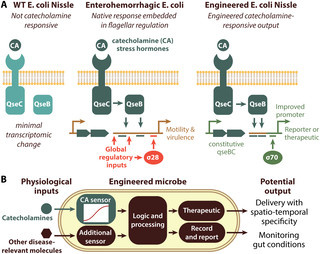
In a groundbreaking study published in PLOS Biology, researchers have investigated how pathogens can sense host stress hormones in the gut and use this information to regulate their motility and virulence. This study specifically focuses on the transfer of the adrenergic-sensing QseBC pathway from enterohemorrhagic Escherichia coli (EHEC) to the probiotic E. coli Nissle 1917, aiming to create a programmable system that can respond to host signals. The researchers found that catecholamines, such as norepinephrine and epinephrine, can influence the behavior of gut microbes by altering their growth and virulence. By engineering E. coli Nissle to incorporate the QseBC pathway, the study demonstrates that it can now respond to these hormones, potentially leading to innovative therapeutic applications. The QseBC system consists of a two-component regulatory system where the sensor kinase QseC detects external signals and activates the response regulator QseB, which then modulates gene expression. The researchers conducted transcriptomic analyses and found that the engineered E. coli Nissle exhibited a broader range of gene expression changes in response to norepinephrine compared to the wild-type strain. They identified specific promoters that could be used for norepinephrine-dependent expression of therapeutic proteins, ultimately enhancing the bacterium's ability to produce therapeutic agents in response to host signals. This engineering approach not only simplifies the regulatory complexity of the native system but also allows for more predictable outputs. The study also delves into the structural aspects of the QseC sensor, identifying key residues that contribute to its signaling capabilities. The engineered E. coli Nissle was shown to produce a therapeutic cargo, a rat α-helical antagonist of the corticotropin-releasing factor (CRF) receptor, which retained its biological activity and inhibited pro-inflammatory responses in macrophages. This research represents a significant advancement in the field of synthetic biology, as it opens up new possibilities for developing living medicines that can respond dynamically to the physiological conditions of the host. The findings suggest that engineered gut bacteria could be programmed to sense various intestinal conditions and adjust their therapeutic outputs accordingly, potentially revolutionizing treatment strategies for diseases characterized by fluctuating symptoms. However, the study also highlights the need for further research to calibrate the engineered systems in vivo and ensure their efficacy and safety in complex biological environments. Overall, this work lays the groundwork for future developments in microbial therapeutics that are responsive to host signals, paving the way for more effective and personalized treatment options.