Modeling Exercise-Induced Skeletal Muscle Hypertrophy Through Mechanochemical Processes
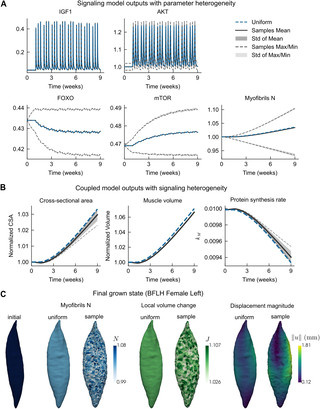
Skeletal muscle is highly adaptable, changing its size and strength in response to physical activity, a process essential for both athletic training and rehabilitation. However, accurately predicting how specific training routines will alter muscle shape remains a challenge due to the complex interplay of mechanical and biochemical factors involved in muscle growth. In a recent study, researchers developed a multiscale computational model that mechanistically integrates these factors, providing a framework for predicting the outcomes of various exercise types on skeletal muscle growth. This model combines a transversely isotropic hyperelastic framework for tissue-level mechanics with a system of ordinary differential equations representing the IGF1-AKT-mTOR-FOXO signaling pathway, a crucial regulator of protein synthesis and degradation. By linking these scales through a volumetric growth model, the researchers enable simulations of long-term muscle adaptation, allowing for the investigation of how different exercise protocols lead to macroscopic hypertrophy. The simulations capture the temporal dynamics of hypertrophy under varying load protocols, revealing how feedback between protein synthesis and muscle growth regulates the dose-response relationship to prevent unbounded growth. Using muscle geometries derived from the Visible Human dataset, the study also examines how variations in muscle geometry can affect hypertrophy. The findings demonstrate that the mechanochemical coupling between muscle geometry and signaling not only predicts macroscopic shape changes but also buffers against local signaling heterogeneity. This framework represents a significant step toward optimizing training regimens and understanding the multiscale determinants of muscle adaptations, highlighting the importance of integrating mechanical and biochemical perspectives in muscle research. The research was published in PLOS Computational Biology and offers a foundational tool for future studies aimed at enhancing athletic performance and rehabilitation strategies.