Model Predicts Bone Density Loss in Astronauts on Long Mars Missions
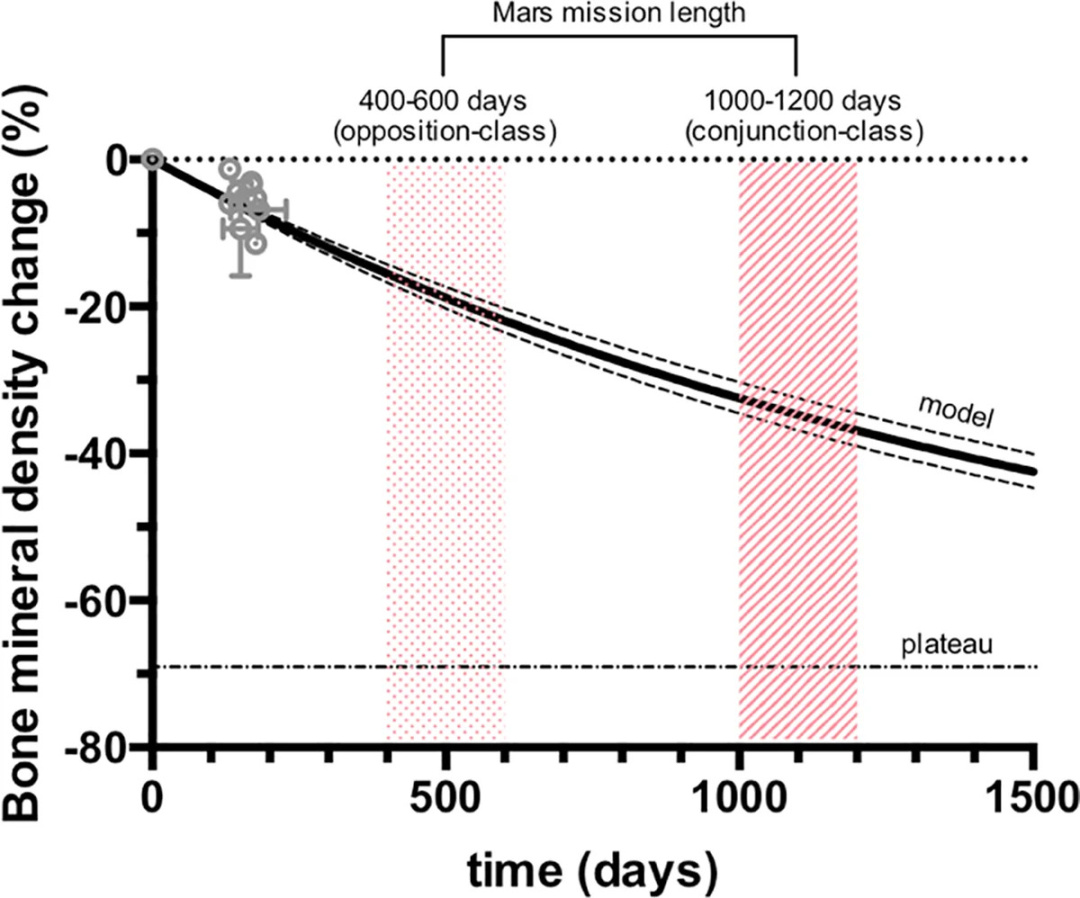
No astronaut has returned from Mars with osteopenia, nor has any human traveled to Mars at all. The warning presented in the headline arises from a mathematical model published in 2020, rather than from clinical follow-up of an interplanetary crew. The authors of this model utilized bone-density data from astronauts on shorter flights and extrapolated these findings to predict outcomes for longer missions. This model serves as a stress test for mission planning, indicating that if femoral-neck bone mineral density follows the projected trajectory without effective countermeasures, a long Mars expedition could lead to significant bone density loss in all modeled cases.
The model was based on data from 69 astronauts, whose bone density measurements were taken after missions lasting between 132 and 228 days. The predictions for a Mars mission, which could last from 1,000 to 1,200 days, extended beyond the available data, necessitating a nonlinear curve fitting approach to estimate potential outcomes. The model suggested that for a conjunction-class mission lasting 1,000 to 1,200 days, the femoral-neck bone density could decrease by 32.4 to 36.8 percent. In contrast, a shorter opposition-class mission lasting 400 to 600 days projected a reduction of 15.6 to 22 percent.
The researchers converted these estimates into T-scores, which measure bone density against a young-adult reference mean. The findings indicated that 100 percent of astronauts on the longer mission profile could develop osteopenia, while roughly one-third could be at risk of osteoporosis. However, it is crucial to note that these percentages are not direct observations but rather model predictions based on demographic averages, not individual astronaut data.
The femoral neck, which connects the femur to the hip socket, is particularly susceptible to changes in mechanical load, which is significantly altered in microgravity. The model did not account for potential countermeasures such as exercise or dietary adjustments that could mitigate bone loss. NASA's Advanced Resistive Exercise Device (ARED), introduced in 2009, has shown that astronauts can maintain bone density close to preflight levels during shorter missions, but the effectiveness of such measures over a three-year mission remains untested.
The limitations of the model are evident; it did not incorporate the effects of deep-space radiation or the unique challenges of living in partial gravity on Mars. The model's predictions should not be interpreted as guarantees of outcomes for future Mars missions. Instead, they underscore the need for thorough planning and countermeasure development to protect astronauts' bone health during extended space travel. The findings from this model are critical for mission designers, highlighting the necessity of ensuring that astronauts maintain adequate mechanical loading to preserve bone density throughout their journey to Mars and back.