Dietary Choices and Their Impact on Sleep Quality: A Study on Fiber and Meal Timing
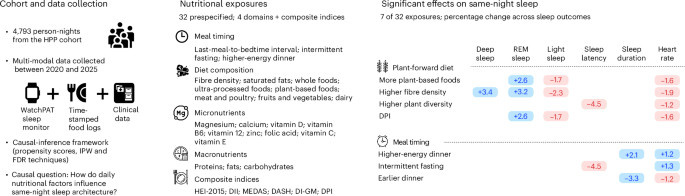
Sleep architecture is crucial for maintaining metabolic and cardiovascular health, yet the effects of daily dietary variations on sleep physiology have not been thoroughly understood. A recent study utilized an observational causal-inference framework, analyzing data from 4,793 person-nights that included real-time dietary logs and multi-stage wearable sleep recordings. This research aimed to investigate how daily nutritional choices correlate with sleep quality on the same night, employing a lagged-variable design to account for the previous day's dietary and sleep patterns. The study estimated causal effects using inverse probability weighting and bootstrap-based methods for uncertainty quantification.
Findings indicated that a higher density of dietary fiber was associated with enhanced restorative sleep. Specifically, participants experienced an increase of 0.59 percentage points in deep sleep (95% confidence interval (CI) = [0.25, 0.94]; P = 0.008) and 0.76 percentage points in REM sleep (95% CI = [0.21, 1.29]; P = 0.008). Conversely, there was a decrease of 1.35 percentage points in light sleep (95% CI = [−2.08, −0.59]; P < 0.01) and a reduction of 1.14 beats per minute (bpm) in mean nocturnal heart rate (95% CI = [−1.67, −0.60]; P < 0.01). The study also found that greater plant diversity, characterized by the daily count of unique plant-based food items, and increased intake of whole-plant foods were linked to lower nocturnal heart rates.
Meal timing behaviors significantly influenced sleep duration and autonomic tone. For instance, heavier evening meals, defined by the percentage of total daily energy consumed in the six hours before bedtime, were associated with an increase of 7.7 minutes in total sleep time (95% CI = [3.71, 12.37]; P < 0.01) and a rise of 0.73 bpm in nocturnal heart rate (95% CI = [0.19, 1.26]; P = 0.032). Additionally, the Dietary Phytochemical Index was positively correlated with restorative sleep-stage composition, leading to increased REM sleep (+0.62 percentage points; 95% CI = [0.11, 1.19]; P = 0.012), decreased light sleep (−1.00 percentage points; 95% CI = [−1.79, −0.28]; P = 0.006), and lower mean nocturnal heart rate (−0.93 bpm; 95% CI = [−1.48, −0.33]; P = 0.002).
In contrast, short-term variations in macronutrient energy distribution and micronutrient intake did not show robust associations after applying false discovery rate corrections. When the analysis focused on more extreme dietary contrasts, the effect sizes increased but remained directionally consistent. These findings underscore the immediate and measurable impacts of daily dietary choices, particularly those emphasizing plant-forward compositions and mindful meal timing, on sleep architecture.