Study Reveals Higher Energetic Costs of Overground Running Compared to Treadmill Running
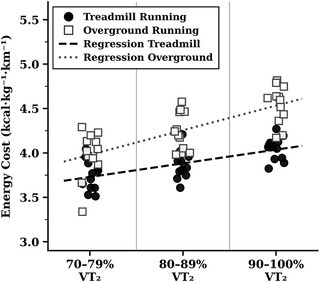
A study published in PLoS One has investigated the physiological and metabolic demands of treadmill versus overground running, focusing on running economy (RE), oxygen cost of transport (O2-COT), and energy cost (EC) in trained endurance athletes. The research involved twelve male runners, with an average age of 21.3 years, who underwent a series of tests to determine their maximum oxygen uptake (V̇O2max) and then completed identical protocols both indoors on a treadmill and outdoors on a 400-meter track. The study aimed to evaluate the differences in energetic costs associated with each running condition.
The findings indicated that RE was significantly higher during overground running, with values of 51.3 mL·kg⁻¹·min⁻¹ compared to 49.6 mL·kg⁻¹·min⁻¹ on the treadmill, particularly at intensities between 70% and 100% of the second ventilatory threshold (VT2). Additionally, O2-COT was consistently greater during overground running across all intensity domains, with measurements of 204.2 mL·kg⁻¹·km⁻¹ for overground running versus 197.1 mL·kg⁻¹·km⁻¹ for treadmill running. The energy cost of running was also higher in the overground condition, ranging from 3.87 to 4.60 J·kg⁻¹·m⁻¹ compared to 3.65 to 4.10 J·kg⁻¹·m⁻¹ on the treadmill.
The study highlights that the commonly used 1% treadmill grade correction does not fully replicate the energetic demands of overground running. This discrepancy has implications for laboratory-based performance evaluations, suggesting that treadmill running may not accurately reflect the true energy costs associated with outdoor running. The study's results emphasize the importance of considering the specific running conditions when assessing endurance performance and training strategies.
Overall, the research provides valuable insights into the differences in energetic demands between treadmill and overground running, which could influence training protocols for endurance athletes. The study was approved by the University Health Sciences Ethics Committee and followed ethical guidelines throughout the research process. The data supporting these findings are available in the Zenodo repository, ensuring transparency and accessibility for further research.














