Study Reveals Intestinal Role in Regulating Growth Under Nutritional Stress
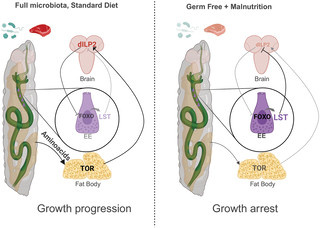
A new study published in PLOS Biology has uncovered significant insights into how developing animals sense nutritional shortages and adjust their growth accordingly. The research, led by Bai and colleagues, emphasizes the developing intestine's pivotal role as a central regulator of a multi-organ signaling system that coordinates animal growth in response to the microbiome and nutritional deficiencies. The study focuses on the gut-derived peptide hormone Limostatin (Lst), which is produced by a specific subset of enteroendocrine cells located in the anterior midgut of Drosophila melanogaster larvae. This hormone acts as a nutrient-sensitive signal that suppresses the brain-derived insulin-like peptide 2 (dILP-2) during periods of malnutrition, thereby slowing development and enhancing survival under adverse nutritional conditions.
The researchers provided compelling genetic evidence demonstrating that Lst functions as a brake on growth in nutrient-limited environments. When the fat body, which serves a similar function to the liver and adipose tissue in insects, senses nutrient scarcity, it reduces the production of dILP-2 in the brain. This reduction activates the transcription factor Foxo in enteroendocrine cells, leading to increased expression and secretion of Lst. This process further suppresses circulating dILP-2, reinforcing the organism's growth-restraining response to nutritional challenges. The study found that loss of Lst function from enteroendocrine cells accelerates developmental progression during malnutrition, while overexpression of Lst delays development. Notably, these effects are specifically linked to protein deprivation, indicating that Lst is a nutrient-dependent regulator rather than a constant suppressor of growth.
Previous research has identified Limostatin's role as an insulin signaling inhibitor in adult Drosophila, where it is produced by the corpora cardiaca, an endocrine organ outside the gut. However, this study reveals a distinct developmental role for Lst, suggesting that its production is primarily tuned to protein availability during larval growth. This finding may reflect an evolutionary adaptation to the increased demand for amino acids during this critical growth phase.
The study also raises intriguing questions about the mechanisms underlying Lst's actions. Future research may explore what receptor mediates Lst's developmental effects and why Lst-producing enteroendocrine cells are selectively sensitive to systemic insulin signals. Such investigations could uncover further diversity and specialization within the enteroendocrine system of the developing intestine. Moreover, while no direct human counterpart to Lst has been identified, the neuropeptide Neuromedin U (NMU) has been proposed as a potential functional equivalent, suggesting that insights from this study could extend beyond insects to inform our understanding of growth and nutritional adaptation in mammals.