Long-Term Persistence of CD19 CAR T Cells in B Cell Lymphomas Observed for a Decade
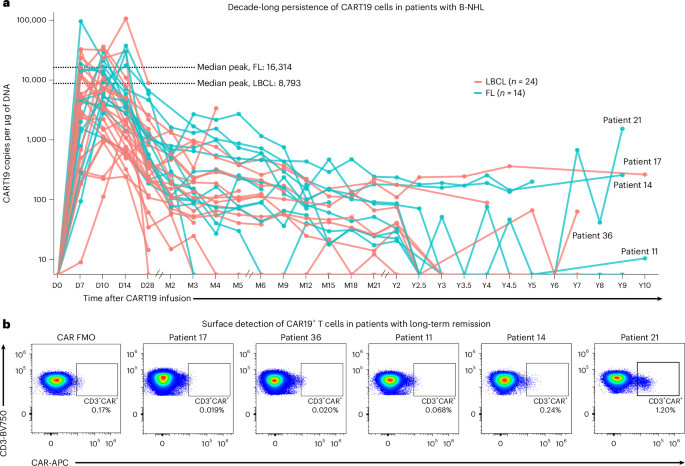
Chimeric antigen receptor (CAR) T cell therapy has significantly changed the treatment approach for relapsed or refractory B cell malignancies, particularly in non-Hodgkin lymphomas (NHL). A recent study reported the persistence and characteristics of 4-1BB-costimulated anti-CD19 CAR T cells (CART19) in patients with B cell lymphoma, demonstrating that these cells can be detected for up to ten years following infusion. The study involved 38 patients who received CART19 therapy, with findings indicating that beyond five years, the CAR19 transgene was still detectable in five of eight long-term responders, suggesting sustained functional activity. Notably, three of these patients maintained B cell aplasia, a sign of effective CAR T cell function. In one patient with a remarkable progression-free survival of 10.1 years, CART19 cells constituted 1.2% of circulating T cells nearly a decade after treatment. The long-term persisting CART19 cells exhibited a unique double-negative (CD4−CD8−) effector-memory-like phenotype, which was associated with increased aerobic metabolism and T cell activation programs. Longitudinal profiling revealed a shift from CD8+ to double-negative CAR T cells over time, indicating an evolution in the CAR T cell population. The study also highlighted that these persisting CART19 cells shared transcriptional features with long-term CAR T cells seen in other hematological malignancies, suggesting a common trajectory in CAR T cell persistence. T cell receptor sequencing demonstrated oligoclonal persistence at 9.3 years, with a dominant clone already detectable at low frequency shortly after infusion. The findings underscore the potential for CART19 cells to provide long-term remission in lymphoma patients, with implications for future CAR T cell therapies. The study was registered under ClinicalTrials.gov with the identifier NCT02030834, and the results contribute to a growing body of evidence on the durability of CAR T cell therapy in treating B cell malignancies. Overall, these insights into the long-term characteristics of CAR T cells could inform treatment strategies and patient management in the future.














