Interferon-Stimulated Genes RSAD2 and CMPK2 Regulate Epstein-Barr Virus Reactivation
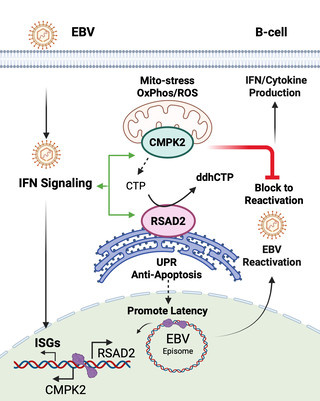
Epstein-Barr Virus (EBV) infection is a complex process that involves the regulation of host immune responses and viral latency. A recent study has shed light on the roles of two Interferon-Stimulated Genes (ISGs), RSAD2 (also known as Viperin) and CMPK2, in this context. These genes are crucial for the regulation of EBV expression and the cellular immune response during both primary infection and reactivation of the virus. The study found that both RSAD2 and CMPK2 are significantly upregulated during EBV infection, suggesting they play a coordinated role in the host's response to the virus. Notably, depletion of RSAD2 resulted in reduced cell viability and limited the reactivation of EBV, while the depletion of CMPK2 led to increased expression of lytic genes associated with EBV during latency. This indicates that both genes are essential for maintaining the balance between viral latency and reactivation. The research highlights that despite their distinct localizations—RSAD2 at the endoplasmic reticulum and CMPK2 in the mitochondria—these genes converge on shared immunometabolic pathways. Specifically, they are involved in Interferon signaling, MAPK signaling, and mitochondrial function, among others. The findings also reveal that RSAD2 and CMPK2 knockdown affects the expression levels of IRAK1-TRAF6-TAK1, and that RSAD2 overexpression can downregulate NF-κB signaling, which is influenced by the EBV membrane-associated oncoprotein LMP1. Furthermore, the study indicates that EBV reactivation induces the formation of antiviral ribonucleotide ddhCTP, a process that is strictly dependent on RSAD2. This research underscores the importance of understanding how EBV manipulates host factors to control its lifecycle and the immune response, which is critical for developing targeted therapies against EBV-associated diseases. The implications of these findings extend beyond EBV, as they may also inform our understanding of other chronic viral infections and their impact on metabolic health.














