Study Reveals How Effector Gene Changes Impact Pathogen Host Range and Fitness
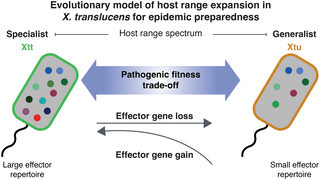
A study published in PLOS Pathogens investigates the evolutionary mechanisms that allow pathogenic microorganisms to adapt to new hosts, specifically focusing on the cereal pathogen Xanthomonas translucens. This research is crucial as it addresses the challenges posed by disease outbreaks in agriculture, which can significantly impact food systems and public health. The study reveals that a subgroup of X. translucens, which is a generalist pathogen, emerged from a specialist ancestor. This transition was facilitated by the loss of a specific effector gene, xopAL1, which enabled the pathogen to jump from barley to wheat. However, this adaptation comes with a significant fitness cost when colonizing barley, indicating a trade-off between host range and pathogen virulence. Additionally, the research identified that the specialist lineage of X. translucens gained an effector gene, xopAJ, which enhances its virulence on barley while limiting its ability to infect oats, thus reinforcing its niche specialization. The authors conducted transcriptomic analyses that showed xopAL1 triggers a defense response in wheat, which reduces photosynthetic processes, further complicating the pathogen's interactions with its hosts. This work provides an experimentally validated framework for understanding how single genetic events can shape ecological behaviors and the potential risks of host jumps in pathogens. By elucidating these mechanisms, the study aims to inform future epidemiological tracking and mitigation strategies against disease outbreaks in agricultural systems, emphasizing the importance of understanding pathogen evolution in the context of food security.