Study Links Oral Glutamate Administration to Increased Atherosclerosis in Mice
A recent study published in PLoS One examines the relationship between oral glutamate administration and the progression of atherosclerosis in high-fat diet-fed ApoE ⁻ / ⁻ mice. Atherosclerosis, a chronic inflammatory disease of the vascular system, is a significant contributor to cardiovascular diseases, which are a leading cause of global morbidity and mortality. The study aimed to determine whether exogenous glutamate could accelerate atherosclerosis progression and to identify associated proteins that may play a role in this process.
In this experiment, atherosclerosis was induced in ApoE ⁻ / ⁻ mice by feeding them a high-fat diet for three months. The mice were divided into four groups: one group received glutamate with the high-fat diet (AS-GLU), another received only the high-fat diet (AS), a third group received glutamate with a normal chow diet (Glu), and the control group received normal chow with a placebo. The researchers assessed atherosclerotic lesions using Lillie's oil red O staining and histological analysis, while proteomics profiling was employed to identify differentially expressed proteins.
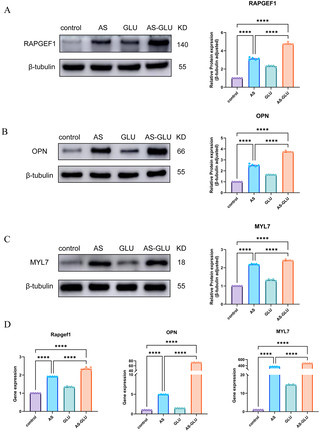
The results indicated that glutamate administration alone led to minimal plaque formation. However, when combined with a high-fat diet, the AS-GLU group exhibited a significantly greater atherosclerotic plaque area compared to the AS group. Proteomic analysis revealed that the expression of proteins RAPGEF1, OPN, and MYL7 was increased in the AS-GLU group compared to the AS group, suggesting a potential link between glutamate exposure and atherosclerosis progression.
Despite these findings, the study noted that serum glutamate levels did not significantly increase, indicating that the effects observed may be localized within the vascular wall rather than systemic. This raises questions about the mechanisms by which glutamate might influence atherosclerosis and whether these findings could be relevant to human dietary practices.
The authors emphasize the need for further research to clarify the role of these proteins in the context of glutamate exposure and to explore the implications for cardiovascular health. This study contributes to the understanding of how dietary components may influence cardiovascular disease risk and highlights the complexity of nutritional impacts on health.














