Study Links Cardiovascular-Kidney-Metabolic Burden Categories to Mortality in Vietnam
The American Heart Association (AHA) has introduced the concept of cardiovascular-kidney-metabolic (CKM) health, which integrates metabolic, kidney, and cardiovascular risk. However, the full staging of CKM health requires specific variables that are often not available in retrospective outpatient datasets, particularly in Southeast Asia. This study aimed to determine whether pragmatic CKM burden categories, derived from commonly available baseline diagnoses, could identify Vietnamese outpatients at higher risk of 5-year all-cause mortality.
Conducted as a retrospective cohort analysis, the study involved 480 adult outpatients recruited from January 1 to December 31, 2016, in Ho Chi Minh City, Vietnam. Participants were classified into four CKM burden categories: Category A (no metabolic-risk diagnosis, chronic kidney disease (CKD), or coronary artery disease (CAD)), Category B (metabolic-risk diagnosis only), Category C (CKD or CAD, but not both), and Category D (both CKD and CAD). The primary endpoint was 5-year all-cause mortality, with data analyzed using logistic regression and complementary time-to-event analyses.
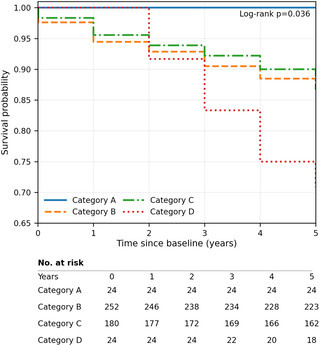
The cohort primarily consisted of individuals aged 40 to 60 years, with 42.5% being men. The distribution across the CKM burden categories was as follows: Category A had 5.0%, Category B 52.5%, Category C 37.5%, and Category D 5.0%. Over 2243.1 person-years of follow-up, 64 deaths occurred, resulting in an overall mortality rate of 13.3%. Notably, the mortality rate was 0% in Category A, 13.1% in Category B, 13.3% in Category C, and 29.2% in Category D. Kaplan-Meier survival curves indicated significant differences across categories (log-rank p = 0.036).
The analysis revealed that individuals in Category D had more than three times the odds of 5-year mortality compared to those in Categories A and B, even after adjusting for age and sex. This suggests that the combination of CKD and CAD significantly elevates mortality risk. However, the findings also indicate that Category C was not associated with increased mortality risk.
In conclusion, the study underscores the utility of pragmatic CKM burden categories in identifying high-risk patients within the Vietnamese outpatient population. The results advocate for further prospective validation of these categories to enhance risk stratification and management in clinical practice. It is important to note that these pragmatic categories should not be interpreted as official AHA CKM stages, and further research is necessary to confirm these findings in broader populations.