Investigating the Kinetic Properties of β-Galactosidase from Palm Weevil Larvae
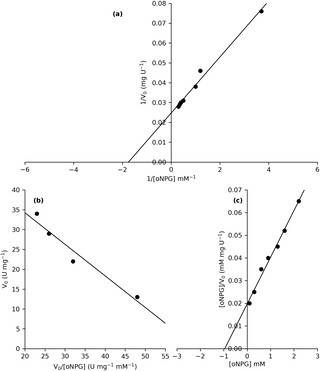
A study published in PLOS One investigates the kinetic and physicochemical properties of β-galactosidase derived from the larvae of the palm weevil, Rhynchophorus palmarum. This insect is not only a pest threatening palm trees in tropical regions but also a promising source of biocatalysts. The research focuses on the enzyme's catalytic activity using o-nitrophenyl-β-D-galactopyranoside (oNPG) as a substrate. The findings reveal that the purified enzyme exhibits optimal activity at a temperature of 330.0 ± 1.2 K and a pH of 5.0 ± 0.1. The study estimates the activation energy (Ea) at 56.3 ± 9 kJ mol-1, providing insights into the enzyme's efficiency. Additionally, the pK values for the enzyme-substrate complex were determined, offering further understanding of the catalytic residues involved in the reaction. Through nonlinear regression analysis, key kinetic parameters were established, including a catalytic constant (kcat) of 4.9 × 10³ s-1, maximum velocity (Vmax) of 49 ± 2 U mg-1, and Michaelis constant (Km) of 0.77 ± 0.08 mM. These results underscore the potential of insect-derived β-galactosidases for industrial applications, particularly in biocatalysis. The study also discusses the importance of temperature and pH on enzyme activity, which follows a bell-shaped curve, indicating that both factors significantly influence the enzyme's performance. The research contributes valuable knowledge to the field of biocatalysis, highlighting the untapped potential of insect enzymes in various industrial processes. Overall, this study not only sheds light on the biochemical characteristics of β-galactosidase from R. palmarum but also opens avenues for future research into its applications in biotechnology, emphasizing the need for further exploration of insect-derived enzymes.














