Introducing Multi-Ancestry Colocalization Approaches to Enhance Genetic Analysis
Genome-wide association studies (GWAS) have identified thousands of genetic variants associated with complex traits, yet many of these variants are non-causal. The challenge lies in pinpointing the causal variants among numerous associated ones. Statistical fine-mapping methods are designed to tackle this issue by differentiating causal variants from correlated tagging variants. Traditionally, these methods have been limited to single ancestry analysis, but recent advancements have introduced multi-ancestry approaches, such as SuSiEx and MsCAVIAR, which utilize differences in linkage disequilibrium (LD) and minor allele frequencies (MAFs) across various ancestries to enhance fine-mapping resolution.
Despite these advancements, the biological interpretation of the identified putative causal variants often remains unclear, especially when these variants are located in non-coding regions of the genome. To improve interpretability, colocalization methods integrate GWAS data with other functional genomics datasets, such as expression quantitative trait loci (eQTL) data, to determine if two traits share the same causal variants. However, existing colocalization methods have not been adapted for multi-ancestry data, creating a gap in the literature.
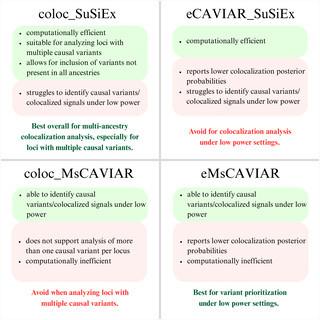
This study introduces four new multi-ancestry colocalization approaches: coloc_SuSiEx, eCAVIAR_SuSiEx, eMsCAVIAR, and coloc_MsCAVIAR. These methods are developed by integrating multi-ancestry fine-mapping techniques with traditional single ancestry colocalization methods. The performance of these new approaches was rigorously evaluated through simulation studies, demonstrating their efficacy in identifying causal variants across diverse populations.
The proposed multi-ancestry colocalization approaches follow a two-step procedure. In the first step, multi-ancestry fine-mapping is performed using either SuSiEx or MsCAVIAR, utilizing ancestry-specific summary statistics and corresponding LD reference panels. The output includes fine-mapping credible sets and the probability of each variant being included in these sets. In the second step, these outputs are analyzed through coloc or eCAVIAR for colocalization analysis, which does not require LD reference information. The colocalization analysis yields the locus-level colocalization posterior probability (lCLPP) and conditional variant-level colocalization posterior probabilities (cvCLPPs).
The study applies these new methods to perform a colocalization analysis of multi-ancestry type 2 diabetes (T2D) GWAS data from the DIAMANTE Consortium alongside European protein quantitative trait loci (pQTL) data from the INTERVAL study. This research highlights the increasing need for multi-ancestry approaches in genetic analysis as more diverse data becomes available, ultimately aiming to facilitate better understanding and interpretation of complex traits in metabolic health.