Queuosine tRNA Modification Influences Virulence in Leishmania mexicana
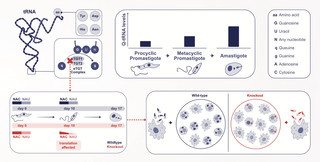
The study investigates the significance of queuosine (Q) tRNA modification in the protozoan parasite Leishmania mexicana, which is responsible for cutaneous leishmaniasis in North and Central America. The research highlights that the complex life cycle of L. mexicana necessitates rapid translational adaptation to survive in both insect vectors and mammalian hosts. Unlike many eukaryotes, Leishmania lacks conventional transcriptional control, making tRNA modifications a potential mechanism for post-transcriptional regulation of gene expression. The study reveals that levels of Q-tRNA increase significantly during the transition from the insect stage to the mammalian-infective stage, suggesting its vital role in virulence. Researchers generated mutant cells lacking the enzyme tRNA-guanine transglycosylase (TGT), responsible for Q incorporation. These mutant cells exhibited notable changes in their proteome during in vitro differentiation. Specifically, proteins downregulated in the mutants were enriched in NAU codons, while upregulated proteins predominantly contained NAC codons. Although these knockout parasites displayed normal growth and differentiation in vitro, they showed impaired survival within macrophages and reduced pathogenicity in mice. This underscores the importance of Q-tRNAs under stress conditions. The findings provide direct evidence that queuosine tRNA modification is critical for controlling the infectivity of Leishmania through codon-biased translation. Traditionally, gene expression regulation in Leishmania has focused on RNA stability and processing, but this research emphasizes the regulatory role of tRNA modifications. The study concludes that Q-tRNA modification adds a novel layer of gene expression regulation, which is essential for maintaining translational balance and facilitating the parasite's adaptation to fluctuating environments, ultimately contributing to its virulence.














